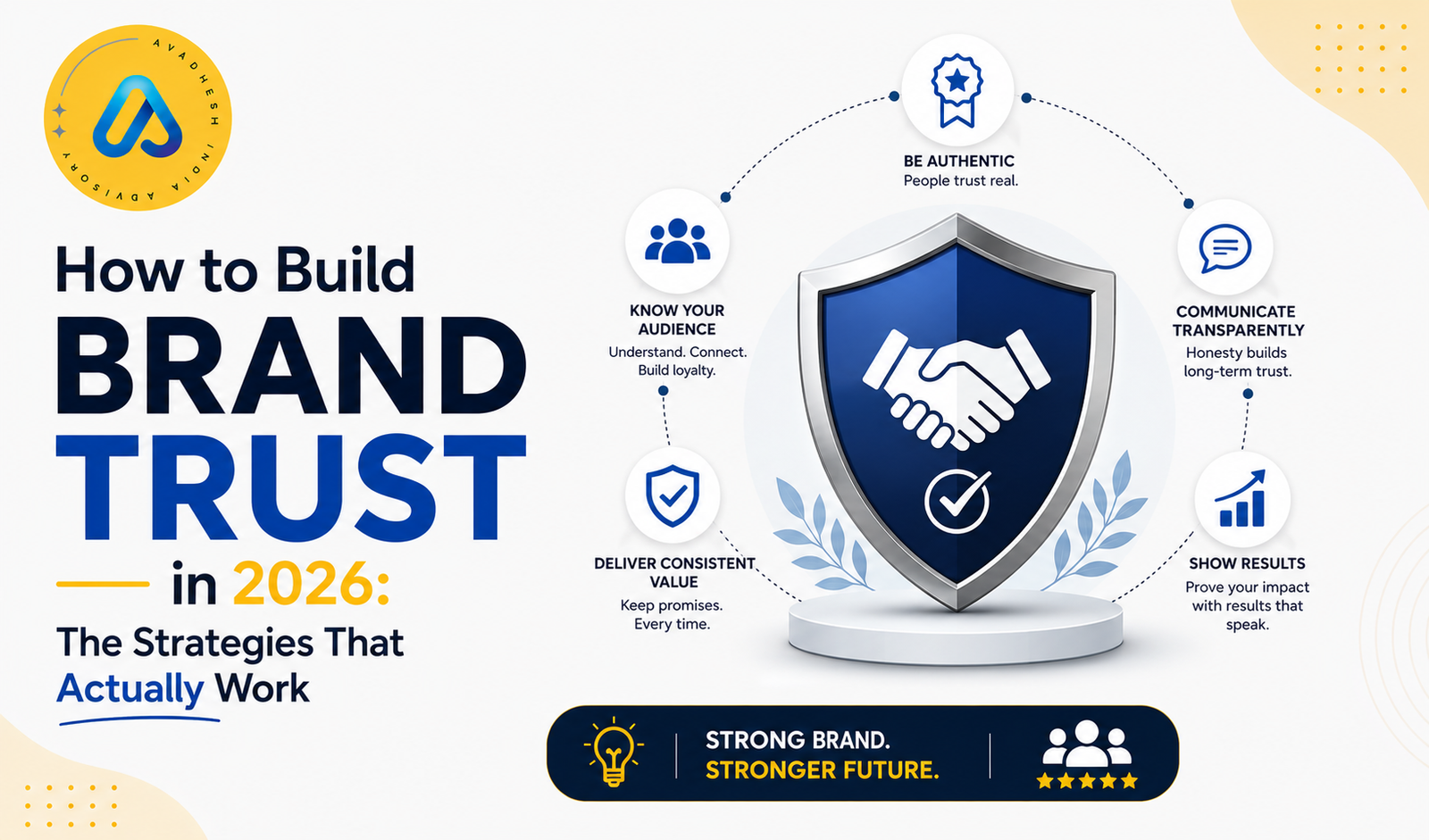
Trust isn’t given.
It’s built.
81% of consumers say they need to trust a brand before buying. Not like it. Not know it. Trust it. And trust isn’t a mysterious quality some brands are born with — it’s built deliberately, through specific actions, repeated over time.
of consumers say they need to trust a brand before making a purchase
stay loyal to brands that are open and honest with them
trust the brands they use more than media, government, or NGOs
trust in advertising — up 8 points, but still under half
Trustworthy enough to keep them?
When was the last time you bought something from a brand you didn’t trust? Probably never. And when did you last stay loyal to a brand that let you down — that promised something and didn’t deliver, felt fake, or handled your data carelessly? Probably not for long.
That’s the reality of doing business in 2026. Trust is not a soft, intangible “nice to have.” It is the single most important commercial asset your brand owns — and the hardest one to rebuild once damaged.
Nearly every customer you have is one broken promise away from walking out the door permanently.
The good news: trust is buildable. And in 2026 — with AI-generated content flooding every channel, consumers more skeptical than ever, and data privacy concerns at an all-time high — the brands investing in genuine trust are pulling ahead of everyone else.
Every action is a trust signal
A landmark Nielsen report found consumer trust in advertising climbed to 47% — an 8-point jump in a single year, driven by brands getting serious about transparency. That sounds like progress. But flip the number: more than half of consumers still don’t trust the advertising they see.
The Edelman Trust Barometer 2026 found something even more telling: 80% of people now trust the brands they use more than they trust media, government, or NGOs. Brands have become one of the most trusted institutions in people’s lives. An enormous opportunity — and an enormous responsibility.
Because trust, once earned, is fragile. Capgemini’s 2026 research shows transparent pricing and consistent experiences now rival cost as drivers of loyalty. Consumers aren’t just evaluating whether your product is good — they’re auditing your entire behaviour: your pricing, your social responses, your data practices, your values, and your actions during difficult moments.
8 strategies to build brand trust in 2026
Not buzzwords. Real strategies, with the evidence behind each one.
Transparency
Only 15% of people believe brands are truly transparent on their social platforms. That means 85% of your audience reads your posts with skepticism already baked in — and that gap is the trust deficit every business must address.
Real transparency means being open about pricing rather than burying fees in fine print. Explaining why prices went up instead of hoping nobody notices. Sharing your sourcing, your sustainability efforts — and yes, your challenges. Brands that contextualise change through honest, proactive communication preserve confidence. The ones that go quiet and hope it blows over watch their trust scores fall.
Consistency
The brands customers trust most show up the same way every time — in messaging, service, product quality, and tone — regardless of whether it’s their best quarter or their worst. Qualtrics’ research consistently ties consistency directly to retention and recommendation.
Think of the brands you personally trust. They’re probably not the flashiest. They’re the ones that have never surprised you in a bad way. The coffee shop that makes your order right every time. The software that just works. The brand that answers complaints the same way it answers compliments.
Genuine engagement
Most brands treat social as a broadcast channel — post, post, post — then wonder why trust isn’t growing. In 2026, building trust is as much about listening as speaking.
- 62% feel more loyal to a brand that responds to their questions on social
- 60% expect a response within 10 minutes
- 90% rate fast response as important to their trust in a brand
When a brand responds quickly, honestly, and helpfully, the customer feels seen. That feeling is worth more than any advertisement you could run.
Social proof
A universal human truth that hasn’t changed: we trust other people more than we trust companies. 98% of consumers now read reviews before buying online.
Because people know a perfect score looks curated. Authenticity — even slightly imperfect authenticity — is more convincing than polish.
- Testimonials and case studies that tell real stories
- User-generated content from actual customers
- Influencer partnerships that feel genuine, not paid-for
- Employee advocacy — your team talking honestly about your brand
Ethical practices & real values
64% of consumers under 40 make purchasing decisions based on values alignment — specifically climate accountability, labour ethics, and data privacy, per Nielsen’s Global Sustainability Report.
But here’s the distinction catching more brands out every year: there’s a massive difference between having values and performing values. Genuine action on sustainability, ethical sourcing, fair labour, or community impact builds real trust. A rainbow logo in June and a green banner in April with nothing behind them actively erodes it — especially with Gen Z, who spot performative branding instantly.
Quality content
82% of consumers feel more positive about a brand after engaging with useful, educational content. Not promotional. Not sales. Content that helps them solve a problem or understand something they didn’t before.
This matters more in 2026 because AI now produces enormous volumes of generic, surface-level content. Brands publishing original insight, real data, honest opinions, and genuinely useful information stand out sharply against a sea of AI-generated sameness.
- Honest comparisons that admit your product isn’t right for everyone
- Guides that help your audience even if they never buy
- Behind-the-scenes content showing who your team is
- Thought leadership that takes a real position rather than sitting on the fence
- Success stories with specific, real outcomes — not vague testimonials
Data security
75% of consumers say they will not buy from companies they don’t trust with their data. Data protection is now the single most important trust factor in digital commerce. A breach doesn’t just cost you legally — it destroys the trust of every customer who finds out. And in 2026, they will find out.
- Be transparent about what data you collect, and why
- Give customers genuine control over their own information
- Never use data in ways that feel invasive or unexpected
- Be clear about AI-driven personalization — 44% are open to AI recommendations, but only from companies they already trust
AI personalization — with a human heart
70% of retailers say AI is critical to their business, but consumer trust in AI-driven brand interactions lags significantly behind. That gap — between how confidently brands deploy AI and how comfortable consumers feel — is one of the defining trust challenges of 2026.
The brands getting it right do two things. First, they’re transparent about AI use — not hiding it, not pretending a chatbot is human, not generating fake reviews or misleading personalization. Second, they keep humans in the moments that matter. Escalations, complaints, crises, high-value interactions — these shape perception, and technology can’t replace the judgment and empathy they require.
Trust is earned in the small moments.
It’s not built in your big campaigns. Not in your brand launch, your rebrand, or your viral moment. It’s built in the small, everyday interactions that most brands never think twice about.
The email arrived when it was supposed to.
The refund was processed without an argument.
The social comment got a genuine, human response.
The pricing page was honest and clear.
The packaging matched the product description.
Consistency is the quiet differentiator.
According to the Hiebing State of Trust 2026 report, trust starts internally and gets communicated through actions. Consumers today aren’t just evaluating your messaging — they’re auditing your behaviour. Every action, every partnership, every product decision, every response is a trust signal.
The same standards. The same tone. The same experience. Every time.
In 2026, genuine brand trust is the most valuable and most defensible competitive advantage available.
With AI generating more content than ever, skepticism at record levels, and consumers more informed and empowered than at any point in history — trust cannot be faked. It cannot be bought. It has to be built. One honest interaction at a time.
Trust isn’t a campaign. It’s a commitment.
Building brand trust is an ongoing commitment to transparency, consistency, and genuine care for the people you serve. In 2026, that commitment is what separates the brands people choose again and again from the ones they forget the moment something better comes along.
At Avadhesh, we help you build the foundations that earn and keep real customer trust.
The content, the consistency, the communication, and the digital presence. Let’s build a brand your customers can truly rely on.